
How to Develop a Private Label Clothing Line for Your Boutique
Ready to take your boutique beyond wholesale? Developing a private label clothing line can help you differentiate your assortment, strengthen your brand identity, and create products your customers can't find anywhere else. But turning that idea into a profitable collection takes more than finding a manufacturer.
With 25 years of experience in the apparel industry, ARD Fashion Consulting founder Amanda Rango understands what it takes to bring a product from concept to customer. In this guide, Amanda walks you through how to evaluate your boutique's readiness, build a product strategy, plan your budget, navigate sourcing and development, and bring your collection to market.
Whether you're exploring private label for the first time or preparing to take the next step in your business, you'll learn what to consider before investing in your own line.

Ready to Put Your Boutique’s Name on the Label?
You know your customers, understand what they love, and have spent time building a boutique that reflects your unique point of view. Now, you’re thinking about creating something of your own.
Developing a private label clothing line can be an exciting next step for your business. It gives you greater control over your product assortment, creates opportunities to differentiate your boutique from competitors, and allows you to build a recognizable brand beyond the products you curate from other labels.
But creating your own clothing line involves more than choosing a garment, adding a logo, and sending it off to a manufacturer. From product strategy and budgeting to sourcing, sampling, and production, there are several moving parts to understand before you commit your time and money.
The good news? You don't need to be a fashion industry expert to get started. You do, however, need a clear plan and an understanding of what it takes to bring your product from concept to customer.
Here's how to develop a private label clothing line that makes sense for your boutique.
What Is Private Label Clothing? Understanding Wholesale Buying vs. Custom Design
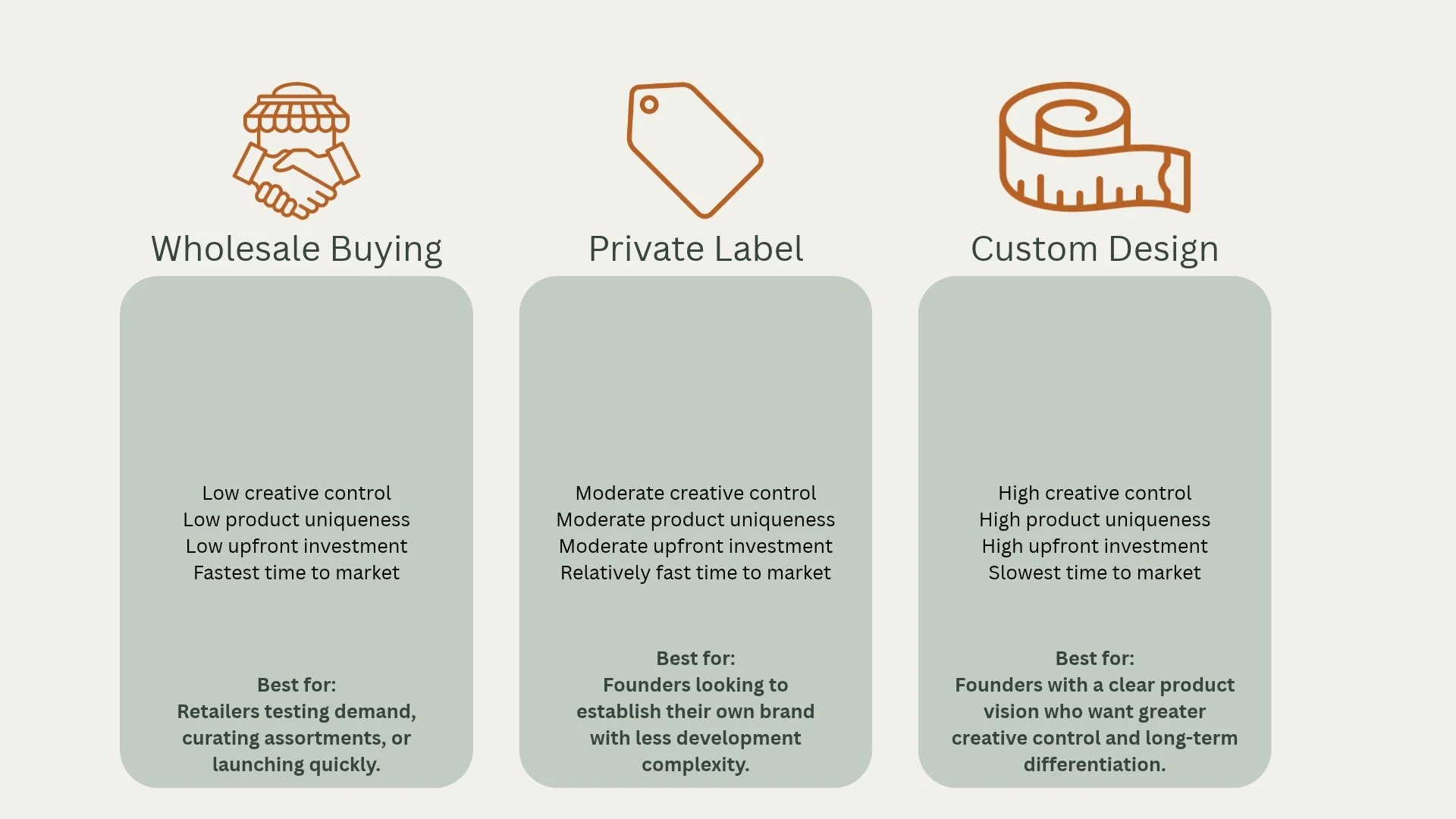
Before diving into product development, let's clarify your options. Wholesale buying, private label, and custom design can all play a role in your boutique's assortment, but they offer different levels of creative control, investment, and product ownership.
Wholesale buying is when you purchase finished products from established brands or vendors and resell them in your boutique. You're selecting products that align with your customer and brand, but the original brand generally controls the design, branding, and product specifications. This is the place most boutique owners start, given it has the lowest barriers to entry.
Private label allows you to sell products under your own brand name, often by working with a manufacturer that offers existing styles you can customize. Depending on the manufacturer, this might mean selecting colors and fabrics, adding your own labels, adjusting certain design details, or making other agreed-upon modifications.
Custom design takes product development a step further. Instead of starting with an existing style, you're developing an original product around your brand's vision and customer needs. This can involve creating new silhouettes, selecting specific materials, developing fit and construction details, and establishing product specifications from the ground up.
So, which approach is right for you?
There isn't one universal answer. Wholesale buying can be a great way to curate a diverse assortment, private label can help you establish a more distinct brand identity, and custom design offers greater control over the products you bring to market. Private label can also serve as a stepping stone between buying from established brands and developing a fully custom collection.
The right path depends on your goals, budget, customer, and appetite for product development. Before making the leap, it's worth understanding what you want to own and where you want your brand to go.
Is Your Boutique Ready to Develop a Private Label Collection?
The idea of creating your own clothing line is exciting. But before you start sketching designs or reaching out to manufacturers, take a step back and evaluate whether your business is ready to make the investment.
Here are a few signs you're in a good position to explore private label.
You understand your customer. You know who shops your boutique, what she's looking for, what she's willing to spend, and what she struggles to find elsewhere. Your customer should be at the center of your product decisions, not an afterthought once the designs are complete.
You have evidence of product demand. Your bestsellers, repeat purchases, customer feedback, and sell-through data can help you identify opportunities. If customers consistently ask for a particular style, fit, or feature, that information can inform your next move.
You have a distinct point of view. Your private label collection should offer a reason for customers to choose your product over something similar from another brand. That doesn't mean every garment needs to reinvent the wheel, but it should serve a clear purpose within your assortment.
You understand the financial commitment. Developing your own collection requires more than paying for the finished garments. You'll need to budget for product development, multiple rounds of samples, production, shipping, and potentially higher minimum order quantities (MOQs). Unlike buying wholesale, where inventory is typically available to sell much sooner, custom development requires you to invest money months before your products are ready for customers. Understanding how that longer timeline impacts your cash flow is an important part of determining whether your boutique is financially ready.
You have a plan for inventory. You understand how a new collection will fit alongside your existing wholesale assortment, how much inventory you can realistically support, and when you need products to arrive for key selling seasons.
You don't need every detail figured out before exploring private label. But the more clarity you have around your customer, product opportunity, and finances, the better equipped you'll be to make informed decisions.
ARD Client Spotlight: MyEllement Boutique
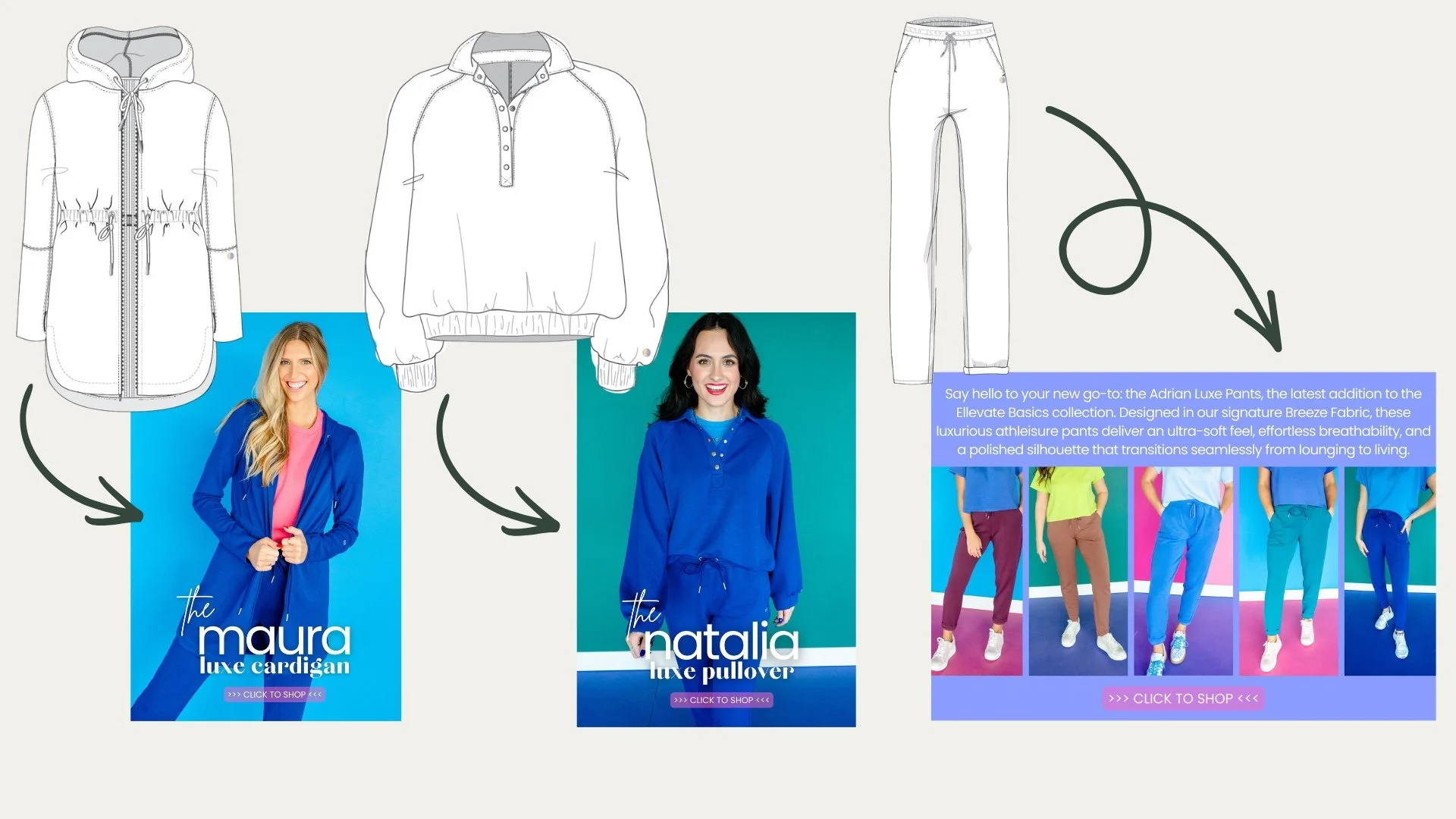
Take MyEllement Boutique, a former ARD client, for example. They had built a strong foundation selling wholesale products but recognized an opportunity to fill a gap in their assortment: high-quality, everyday basics.
Using their existing sales data and product expertise, we helped develop the Ellevate Basic collection, featuring a signature fabric in multiple silhouettes and colorways. The result? A collection that quickly became a top seller!
Sometimes, growth isn't about reinventing your entire business. It's about identifying the right opportunity and building on what already works.
Previous client work for MyEllement Boutique
Step One: Define Your Private Label Product Strategy
Before you contact a manufacturer, you need to know what you're trying to create and why. A strong product strategy helps you make decisions with purpose instead of getting swept up in every fabric swatch, trend, and design possibility that comes your way.
Start by looking for a gap in your current assortment. What are your customers asking for that you aren't currently offering? Which products consistently perform well? Are there opportunities to improve fit, functionality, quality, or price? Review your sales data, customer feedback, returns, and bestsellers to identify patterns that could inform your product direction.
You'll also want to establish a few key parameters:
Target customer: Who is the product for, and what problem or need does it address?
Product positioning: What makes the product different, and where does it fit within your brand?
Target retail price: What will your customer realistically pay?
Product scope: Are you starting with one hero product, a small capsule collection, or a broader assortment?
Success criteria: How will you evaluate whether the product is performing as expected?
If this is your first time developing a private label clothing line, starting small can help you test your assumptions before committing to a larger collection. One thoughtfully developed product that meets a real customer need can be more valuable than ten products without a clear strategy.
Step Two: Build Your Budget and Understand the Costs
Let's talk numbers. Your product idea may be brilliant, but if the financials don't work, bringing it to market becomes a much bigger challenge.
Before committing to production, build a preliminary budget that accounts for the full cost of developing and selling your product. Depending on your product and production model, expenses may include:
Product development and sampling
Fabric, trims, labels, and packaging
Minimum order quantities (MOQs)
Manufacturing and quality control
Freight, duties, and logistics
Product photography and marketing
Inventory storage and fulfillment
Contingency funds for revisions, delays, or unexpected expenses
The exact costs will depend on your garment, materials, level of customization, manufacturing location, and order quantity. Private label can sometimes offer a more accessible entry point than fully custom development, but it isn't automatically inexpensive.
You'll also need to understand the difference between unit cost, landed cost, and retail price.
Your unit cost is the cost to manufacture an individual garment, based on the agreed-upon production terms. Your landed cost accounts for the additional expenses required to get that product to its intended destination, such as freight, duties, and other applicable charges. Your retail price is what your customer pays for the finished product.
These numbers work together to determine whether your product can support your desired margins and overall business goals. A low manufacturing cost doesn't necessarily translate to a profitable product, particularly when additional expenses and potential markdowns enter the picture.
Don't Let a Great Product Idea Become an Expensive Surprise
Before placing an order, build a preliminary investment forecast that considers development expenses, production costs, inventory commitments, and the margin you need to make the business worthwhile.
If you're unsure where to begin, ARD's beginner's guide to understanding product costs and margins in fashion is a helpful place to start.
The goal isn't to predict every expense perfectly. It's to understand your financial commitments before you're locked into them. A little planning now can help you avoid expensive surprises later.
Step Three: Find the Right Partner: Design and Product Development Support
You don't have to be a designer, technical developer, and production manager all rolled into one to develop a clothing line. But you do need a plan for how the work will get done.
For first-time creators, partnering with an experienced apparel consultant can help you navigate the process, make informed decisions, and avoid common product development pitfalls. At ARD Fashion Consulting, we help founders turn ideas into actionable product plans, supporting the process from initial concept through production.
Depending on your needs, this support may include design development, technical sketches, tech packs, fabric and trim sourcing, manufacturer communication, sample reviews & fit evaluations, and production management. Having an experienced partner can be especially valuable when you're unfamiliar with industry terminology, unsure what to ask a manufacturer, or trying to balance product development with running your boutique.
Of course, you can also take a more hands-on approach and manage much of the process yourself. If you choose the DIY route, start by identifying where you need support and where you have the skills to take ownership.
Step Four: Plan Your Production Timeline and Inventory
If you're hoping to launch your collection in time for a particular season, here's your reminder to start planning earlier than you think you need to.
Product development involves multiple stages, and delays in one area can affect everything that follows. Before committing to a launch date, work backward from when you want the product available to customers.
Your timeline should account for:
Initial sourcing and product development.
Fabric and trim availability.
Sample creation and revisions.
Final product approval.
Production scheduling and manufacturing.
Quality checks, shipping, and receiving.
Photography, marketing, and launch preparation.
The time required will vary depending on the garment, manufacturer, level of customization, and production location. A relatively straightforward private label style may follow a different timeline than a fully custom garment requiring new patterns, multiple fit rounds, or specialized materials.
If your boutique depends on seasonal selling windows, build your calendar around those deadlines rather than assuming production will wrap up exactly when you need it to. Our resource, How to Plan Your Fashion Production Calendar, is a great starting point.
Inventory planning is just as important. Determine how much product you can afford to purchase, how the collection will fit alongside your existing assortment, and whether you have enough cash available to support the inventory commitment.
Read our recent blog: How to Plan Your Fashion Production Calendar
Step Five: Develop Your Product Specifications
You've identified your product opportunity, established a budget, and started building your development plan. Now it's time to translate your vision into clear instructions for the people who will help bring it to life.
Even if you're working with an existing manufacturer style, you need to document exactly what you're ordering and which customizations have been agreed upon. Assuming everyone is on the same page is not a product development strategy.
Depending on the complexity of your product, your specifications may include:
Product sketches, reference images, or existing style references.
Fabric, trim, and material selections.
Color specifications.
Label, logo, and branding placement.
Measurements and fit requirements.
Construction details and finishing requirements.
Sample feedback and revision notes.
Final production specifications.
One important tool you may encounter is a tech pack. A tech pack is a technical document that communicates how a garment should be developed and produced. Depending on the product, it may include measurements, construction details, materials, artwork, labeling requirements, and other information necessary for accurate execution.
The documentation you need will depend on your product and how much you're changing from an existing style. Your manufacturer may already have specifications for a base garment, for example, but any agreed-upon customizations still need to be communicated clearly.
Step Six: Find the Right Manufacturer
Start by identifying manufacturers that work with your product category, desired production model, and level of customization. Not every manufacturer offers the same capabilities, and a partner who specializes in one type of apparel may not be the best choice for another.
As you evaluate potential partners, ask questions about:
Product capabilities: Do they manufacture your type of garment and support the customizations you need?
Minimum order quantities: What is the minimum order per style, color, or size, and does it align with your inventory budget?
Sampling: What are the costs, process, and expected timelines for developing and revising samples?
Production timelines: What are their current lead times, and how do they handle delays?
Materials and sourcing: Do they source fabrics and trims, or are you expected to supply them?
Pricing and payment terms: What is included in the quote, and when are payments due?
Quality standards: How do they evaluate product quality, and what inspection processes are available?
Communication: Are they responsive, clear, and willing to answer your questions?
Request relevant examples of their work or references where available. You should also clarify expectations around product specifications, ownership of designs and technical assets, confidentiality where relevant, and any exclusivity arrangements before entering into an agreement.
A manufacturer is responsible for executing the product within the agreed scope. They shouldn't be expected to own your entire product strategy or make every business decision on your behalf. You need to understand what you're asking them to produce, what it should cost, and what quality standards your brand expects.
Step Seven: Review Samples and Approve Production
Before committing to a full production run, you need to make sure the product you're ordering is the product you actually want to sell.
Sampling gives you an opportunity to evaluate the garment, identify issues, and communicate necessary revisions before larger quantities are manufactured. Depending on the product and development process, you may need multiple rounds of samples to get everything right.
During your review, assess:
Fit and measurements: Does the garment fit as intended, and are the measurements consistent with your specifications?
Fabric and materials: Do the weight, hand feel, performance, and overall quality meet your expectations?
Construction: Are the seams, stitching, finishes, and details executed correctly?
Color and trims: Do the materials and colors match the approved selections?
Branding: Are labels, logos, and other brand elements positioned and applied correctly?
Overall customer experience: Does the garment meet the expectations you've established for your brand and price point?
When appropriate, evaluate fit on the intended fit model and document feedback clearly. If something isn't right, communicate the issue and confirm the required changes before approving the next sample.
Once the sample meets your expectations, confirm the final specifications, pricing, order quantities, delivery dates, and quality requirements before authorizing production.
Skipping this step or approving a sample you're not fully confident in can leave you with a large quantity of inventory that's expensive or difficult to fix.
Step Eight: Launch, Merchandise, and Learn
Your product has made it through development and production. Now comes the fun part: introducing it to your customers.
But even a great product needs a thoughtful launch plan. Your customers should understand what makes the collection special, how it fits their needs, and why it's worth purchasing from your boutique.
Prepare your launch by developing product photography, writing compelling product descriptions, and communicating the features that differentiate your collection. Plan how you'll introduce the products through your website, email marketing, social media, and in-store merchandising.
If you have a retail team, make sure associates understand the product's fit, features, materials, and intended customer. The more confidently your team can speak about the collection, the better equipped they'll be to help customers make purchasing decisions.
Once your collection is live, pay attention to performance. Track metrics such as:
Sell-through rates and sales by style, color, and size
Gross margin and markdown activity
Customer feedback and return reasons
Repeat purchases and customer demand
Replenishment opportunities and inventory availability
Your first private label launch doesn't need to be the biggest collection your boutique has ever carried. A smaller, intentional assortment can help you test your product strategy, learn what works, and build a stronger foundation for future development.
Common Mistakes to Avoid When Developing Private Label Clothing
Developing a private label clothing line comes with a learning curve, especially if you're navigating product development for the first time. While every project is different, a few common mistakes can make the process more expensive or stressful than it needs to be.
Developing products without validating customer demand. Just because you love a design doesn't mean it will sell. Use customer feedback, sales data, and market research to establish whether there's a genuine opportunity before committing to production.
Choosing a manufacturer based on price alone. A low quote may look attractive, but manufacturing capabilities, product quality, communication, and reliability are equally important. Evaluate the full partnership, not just the price per unit.
Underestimating the total investment. Manufacturing costs are only one part of the equation. Account for development, sampling, shipping, inventory, and other expenses to understand the financial commitment before placing an order.
Ordering more inventory than your business can support. Large quantities may offer lower unit costs, but they also increase your financial exposure. Make sure your order quantities align with customer demand, available cash, and realistic sales projections.
Setting unrealistic launch dates. Product development takes time, and delays can affect your entire merchandising calendar. Build in realistic lead times and confirm milestones with your development and manufacturing partners.
Expanding too quickly. It's tempting to jump into additional categories once your first collection launches. Before scaling, evaluate performance and use what you've learned to determine where your next investment makes sense.
A successful private label clothing line isn't built by finding a manufacturer willing to put your name on a garment. It's built through thoughtful decisions, clear communication, and a product strategy that supports both your customer and your business.
Build a Private Label Line That Works for Your Boutique
Developing a private label clothing line can be an exciting opportunity to strengthen your boutique's brand identity, differentiate your assortment, and create products that connect more intentionally with your customers.
At ARD Fashion Consulting, we help apparel founders turn ideas into actionable product plans. Whether you're exploring private label for the first time or need support with product development, sourcing, technical documentation, or production management, we can help you understand your options and determine the right next steps for your business.
Ready to bring your boutique's product vision to life? Connect with ARD Fashion Consulting to explore how we can help you build a product strategy that works for your brand.