

The Beginner’s Guide to Understanding Product Costs and Margins in Fashion
If you’re launching a fashion brand, one of the most important skills you can develop is understanding your numbers.
Many new founders start with a great product idea, a clear vision, and strong branding—but without a solid grasp on product costs and margins, even the best designs can struggle to become profitable.
The good news? You don’t need a finance degree to understand it.
In this guide, we’re breaking down the basics of cost of goods sold (COGS), margin, markup, and pricing strategy so you can confidently price your products in a way that supports both your customer and your business goals.

Before you can price your product profitably, you need to know what it actually costs to produce.
Understanding Cost of Goods Sold (COGS)
Cost of Goods Sold (COGS) refers to the total direct cost of producing the items you sell. In fashion, this includes everything directly tied to making the product—from materials to labor to shipping.
If you don’t understand your COGS, it becomes nearly impossible to build a pricing structure that supports profitability.
What Are The Different Types of Costs in Fashion?
Fashion product costs are made up of multiple layers, and many new brands underestimate how much goes into each unit.
Material Costs
These are the raw materials needed to create your product, such as:
Fabric
Trim
Labels
Packaging
Graphics or Print techniques
These costs often make up a large portion of your unit cost, especially depending on the quality of materials you choose.
Labor Costs
Labor covers the work required to physically produce the garment, including:
Cutting
Sewing
Printing
Finishing
Labor costs can vary significantly based on production location, construction complexity, and order volume.
Development Costs
Before your product goes into production, there are development costs that help prepare it for manufacturing:
Patternmaking
Sampling
Grading
These costs are often overlooked, but they are essential to creating a production-ready product.
Shipping & Duties
Getting your goods from the factory to your warehouse or fulfillment center also adds to your cost:
Freight
Import fees
Forwarder / Trucking Transit
Shipping expenses can fluctuate, so it’s important to account for them early in your pricing strategy.
Overhead Allocation
These are operational costs associated with producing and managing inventory, such as:
Warehousing
Quality control
Production management
While overhead isn’t always assigned per unit right away, it still impacts profitability and should be factored into your pricing.
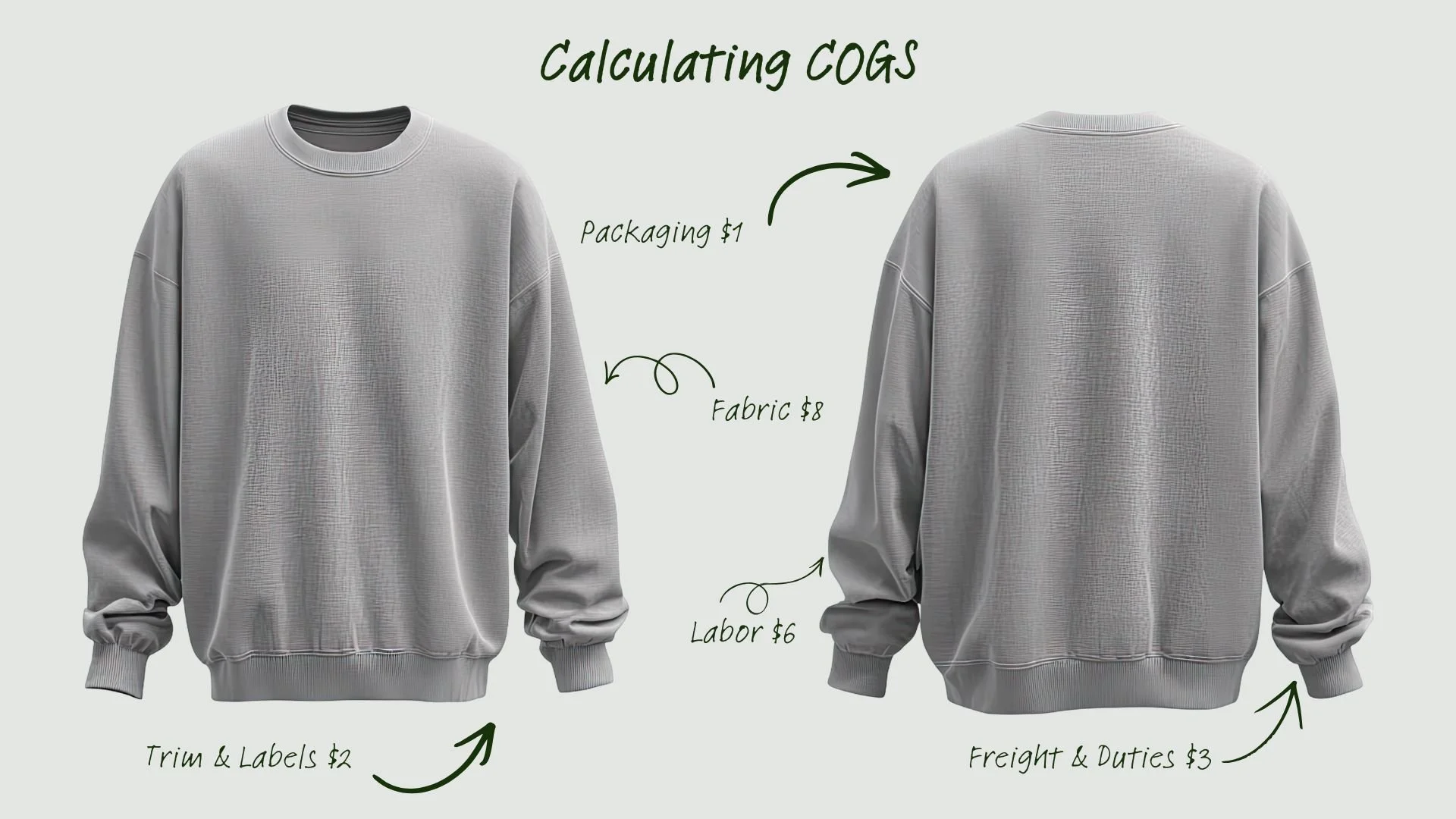
Calculating COGS: An Example
Let’s say you’re producing a sweatshirt:
Fabric: $8
Trim + labels: $2
Labor: $6
Packaging: $1
Freight + duties: $3
Your total COGS = $20 per unit
That means every sweatshirt costs you $20 before you make any profit.
This number becomes the foundation for your pricing decisions.
Margin vs. Markup: What’s the Difference?
Once you know your product cost, the next step is understanding margin and markup.
These two terms are often used interchangeably, but they mean very different things—and confusing them can lead to serious underpricing.
Markup tells you how much you add to your cost to determine the selling price.
Margin tells you how much profit you make from the selling price.
Both are important, but they serve different purposes when building a pricing strategy.
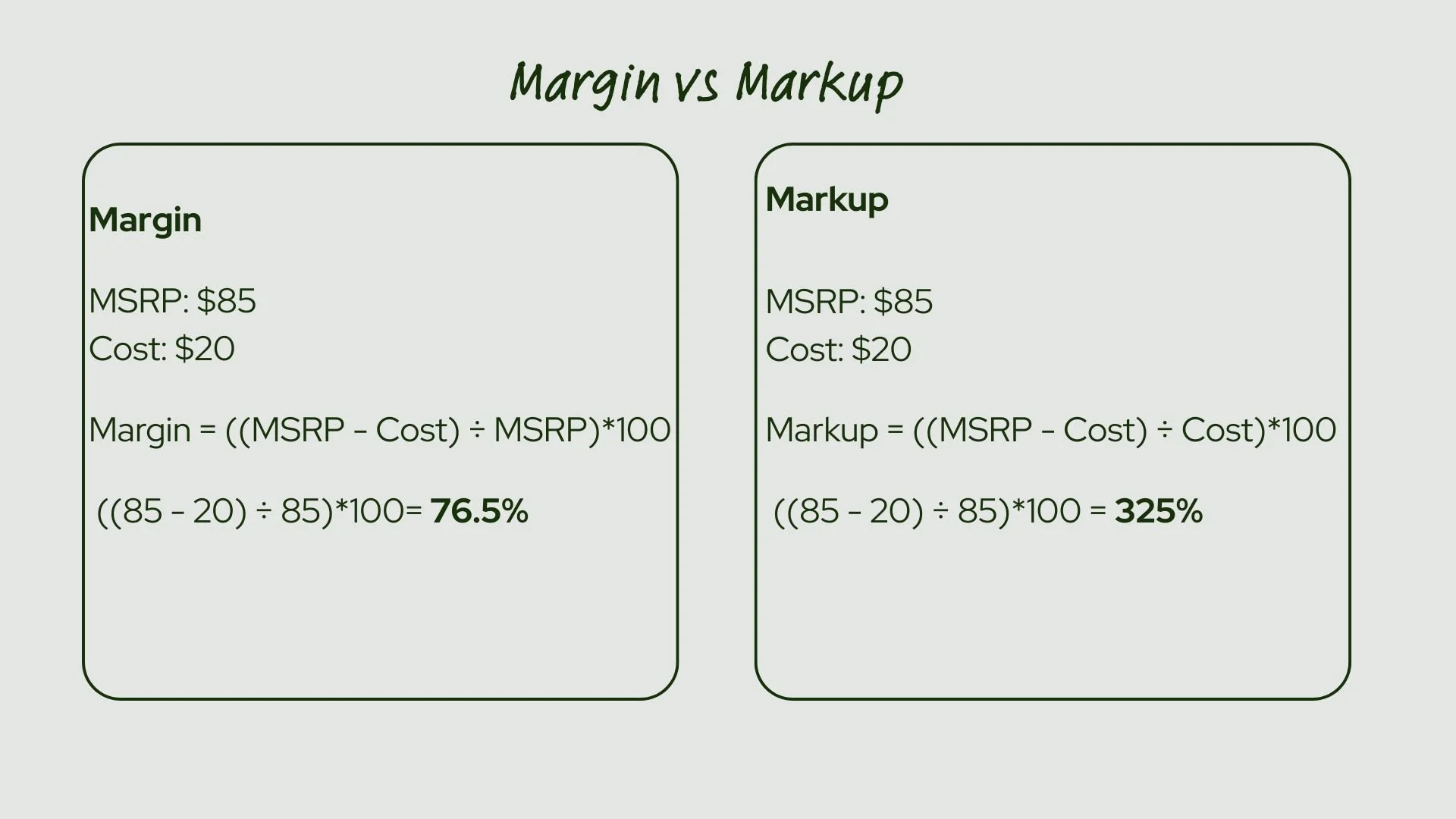
How to Calculate Margin in Fashion
Margin shows what percentage of the selling price is profit.
Formula:
Margin = (Selling Price - Cost)/Selling Price
You might often see the term “Selling Price” referred to as MSRP or Ticket Price. These terms are interchangeable within the formula above.
Example:
If the cost is $20 and the selling price is $85, the margin is 76%.
Said differently, this means 76% of the selling price is profit.
How to Calculate Markup in Fashion
Markup shows how much you increase the cost to arrive at your selling price.
Formula:
Markup = (Selling Price - Cost) ÷ Cost
Example:
If your product costs $20 and sells for $85, the markup is 325%.
Why Is It Important to Know the Difference Between Margin and Markup?
This is where many new fashion brands get confused.
Using this example, a sweatshirt that costs $20 and sells for $85 has:
325% markup
76.5% margin
Those numbers sound similar, but they tell you very different things.
Markup tells you how much the price increased from the cost.
Margin tells you how much of the selling price your business actually keeps.
Understanding the difference matters because margin is what supports the rest of your business—from marketing and shipping to reorders and growth.
If you focus only on markup without understanding margin, you may think your pricing is profitable when your actual retained profit is much lower than expected.
That’s why both metrics are essential when building a pricing strategy that supports long-term growth.
How to Price Your Fashion Product Profitably
Pricing your product profitably means balancing what it costs to produce with what your customer is willing to pay while ensuring enough margin to sustain and grow your business.
Here are the key pricing factors every fashion founder should understand.
Step One of Pricing: Understand Your Product Costs
Before setting a selling price, determine the full cost to produce one unit, including materials, labor, packaging, and shipping.
Example: If your total unit cost is $20, your pricing must be built from that number.
This ensures your price covers all direct expenses before profit.
Step Two of Pricing: Factor in Your Sales Channels
Your pricing strategy should reflect where you plan to sell.
If you sell direct-to-consumer, you keep the full retail price. If you sell wholesale, retailers need room for markup, so your wholesale price is typically half of retail.
Example:
Wholesale Price: $42.50
Retail Price: $85
This structure allows both the brand and retailer to maintain healthy margins.
Step Three of Pricing: Consider Market Positioning
Your price should align with what your customer is willing to pay and where your product fits in the market.
Researching competitors helps you understand customer expectations, but profitability should still drive your pricing decisions.
If your product is priced too low, customers may question quality. If it’s priced too high without a strong brand position, conversion may suffer.
The goal is to find the balance between market value and business viability.
What is Keystone Pricing?
A common pricing strategy in fashion is keystone pricing, where:
Wholesale is double the unit cost
Retail is double the wholesale price
If your unit cost is $20, keystone pricing would look like:
Wholesale: $40
Retail: $80
This model helps create enough margin across both wholesale and direct-to-consumer channels.
While keystone isn’t a one-size-fits-all formula, it’s a strong baseline for building sustainable margins.
Why Strong Margins Matter For Retail Growth
Strong margins do more than generate profit. They create the flexibility your brand needs to grow.
Healthy margins help fund:
Reorders
Marketing
Team growth
Product development
Unexpected expenses
Without enough margin, every challenge becomes harder to absorb.
That’s why margin should be seen as a growth strategy, not just a finance metric.
Hidden Costs New Fashion Brands Forget
One of the biggest pricing mistakes new brands make is assuming the unit cost tells the whole story.
In reality, many hidden costs affect profitability, including:
Sampling revisions
Freight increases
Damages and returns
Marketing expenses
Transaction fees
Inventory storage
Packaging upgrades
A product that costs $20 to make may cost significantly more to sell profitably once these expenses are included.
Planning for these costs early helps prevent margin issues later.
How ARD Fashion Consulting Helps Brands Build Profitable Pricing Strategies
Understanding your costs before production is one of the smartest things you can do for your business.
At ARD Fashion Consulting, we help brands:
Calculate true unit costs
Identify hidden expenses
Build strategic pricing structures
Improve profitability before production begins
This gives founders the clarity they need to make informed pricing decisions—before expensive mistakes happen.
Because the truth is, pricing isn’t just about choosing a number.
It’s about building a business model that supports long-term growth.
If you’re developing a product and want to ensure your pricing strategy is built for profitability, ARD Fashion Consulting can help you build that foundation from the start.