
How to Plan Your Fashion Production Calendar for 2026 (Without the Guesswork)
If you’re planning to launch your fashion brand in 2026 (really 2027 if you’re just getting started), chances are you already know this: you want to do it right.
You don’t want to rush a collection, chase factories for months, or cross your fingers and hope everything works out. You want a thoughtful, well-made collection that reflects your vision — and arrives when it’s supposed to.
To make that happen, you need one essential tool:
a clear, realistic production calendar.
Not something complicated or overwhelming — just a founder-friendly plan that helps you understand what needs to happen, when it needs to happen, and how all the pieces fit together. When your calendar is solid, the process feels calmer, more intentional, and a lot more manageable.
At ARD Fashion Consulting, the very first thing we build with our clients is a clear production calendar.
In this guide, I’ll walk you through how to plan your 2026 calendar step by step, with realistic timelines, helpful tips, and insights to keep you ahead.
Your launch doesn’t need to feel chaotic.
It just needs a proactive plan.
Let’s walk through how to make that happen.
Why your Production Calendar is Essential
Think of your production calendar like the GPS for your brand.
In 2026, with trend cycles speeding up and supply chains still unpredictable, a mapped-out calendar isn’t a nice-to-have, it’s a non-negotiable.
Whether you’re starting fresh or building a seasonal drop, your calendar gives you:
Visibility on what’s coming up (and what’s urgent)
Control over lead times and decisions
Confidence that you’re not missing critical steps
And most importantly, room to breathe and make changes without derailing your launch
Let’s look at two big reasons why 2026 will require even more intentional planning.
Shorter trend cycles
Let’s be real—trends are moving faster than ever.
Thanks to TikTok, digital lookbooks, and seasonless shopping habits, what feels “of the moment” today can feel outdated in a matter of months.
Depending on your brand’s vibe, your collection needs to do one of two things:
Either speak to what’s culturally relevant right now, or offer a timeless, niche perspective that feels deeply considered, not reactive.
Founder Tip: Give yourself at least 4–6 weeks before design begins to research trends, gather inspiration, and shape your creative direction. That early clarity can save you months of revisions later.
Global Supply Chain Shifts
Since 2020, the fashion supply chain has been anything but predictable. And 2026 will still come with its fair share of curveballs.
From fabric delays and fully booked factories to shipping slowdowns and unexpected vendor holidays, the brands that plan ahead are the ones that stay on track.
A reactive brand gets stuck waiting.
A prepared brand builds in buffer weeks, has backup vendors, and maps out realistic timelines in advance.
At ARD, we help clients plan around the real-world stuff — like lead times, sample revisions, vendor closures, and freight delays — so their calendar reflects how production actually works, not just how we wish it would.
Reminder: Your calendar isn’t just a schedule—it’s your safety net.
Key Phases of a Fashion Production Calendar
If you’re building a premium apparel brand, one of the best things you can do is understand what actually goes into your production calendar.
It’s not just about filling in dates. It’s about knowing what needs to happen when, and giving yourself the space to make smart, intentional decisions along the way.
Below, we’ll walk through the 7 key phases—from concept to delivery—so you can start mapping your 2026 plan with clarity and confidence.
Concept Development
Every strong collection starts with a clear, intentional concept.
This phase isn’t about designing on a whim — it’s about grounding your ideas with purpose. Here’s where you define your creative direction, explore white space in the market, and clarify how your product connects with your ideal customer.
Tools like mood boards, color palettes, and trend research help bring your vision to life — but this step goes deeper than aesthetics. It’s about building the emotional foundation of your brand, so every decision moving forward feels aligned.
Founder Insight: Skipping this phase often leads to expensive pivots later. The best time to get clear is before a single sample is made.
Design + Technical Development
Once your concept is clear, this is where your ideas start to take shape.
Sketches become specs. Fabrics get sourced. Your vision turns into factory-ready tools — like tech packs, measurements, and construction notes — that translate creativity into clear execution.
This phase bridges the gap between inspiration and production. It’s what helps your factory send you samples that actually reflect what you imagined — the first time.
2026 Tip: Digital tools like 3D prototyping are becoming more common. They can speed up development, reduce revisions, and cut waste — especially when paired with traditional sampling.
Real talk: This is often where founders get stuck. The technical side can feel overwhelming, but working with a consultant like ARD Fahsion Consulting helps simplify the process, avoid mistakes, and move forward with clarity.

3-D Prototyping done for an ARD Fashion Consulting Client, Highlights for Children
Sampling + Fit Process
This is where your product starts to feel real — and where a lot of emotions come up. It’s exciting, but also humbling, especially if you're new to the process.
Once your designs are technically ready, your factory will create the first round of samples. But here’s the part most first-time founders don’t expect: your first sample probably won’t be perfect.
You’ll go through several rounds — from proto samples to fit samples to sales-ready versions (often called SMS) or Salesman Sample. Each round gets you closer to the product you imagined.
Founder Insight: If that first sample feels off, don’t panic. What matters is having clear feedback, a solid tech pack, and a partner who can help translate changes into factory language.
2026 Tip: Build in extra time for sampling. Between factory delays, shipping, and back-and-forth revisions, this phase always takes longer than you think. Rushing here can lead to expensive mistakes later.
Production Forecasting + Order Quantities
Once your samples are approved, it’s time to shift into production mode — and this is where strategy meets numbers.
Founders often ask:
“How many units should I produce?”
“What if I order too much — or not enough?”
There’s no perfect formula. Your quantity depends on your budget, product type, demand, and business model. The goal is to order confidently — without overcommitting or falling short.
In 2026, be sure to factor in:
MOQs (Minimum Order Quantities)
Fabric availability and lead times
Sales channels (DTC vs. wholesale)
Cash flow and storage capacity
Founder Tip: Don’t aim for perfect. Most founders adjust their order strategy after the first round. Start with realistic goals — you’ll learn and refine as you grow.
This is often the first moment it all feels real. You’re placing actual orders and turning your idea into inventory.
Manufacturing
Your materials are ordered. Samples are approved. Production is booked. Now it’s time to build.
This is the phase where your product officially enters the factory.
Here’s the part many founders underestimate: production only runs smoothly if it’s set up for success. That means:
Coordinating lead times across materials, trims, and factories
Sending clear POs (Purchase Orders)
Approving lab dips, strike-offs, and trims early
Understanding your factory’s capacity and realistic timelines
And most importantly — building in buffers
2026 Reminder: Delays are still common, especially with specialty fabrics like denim, activewear, and sustainable materials. Your calendar should plan for that before it becomes a problem.
Founder Reality Check: This is where working with a production partner changes everything. At ARD, we manage timelines, approvals, and vendor communication so you can stay focused on the big picture, not chasing updates.

Quality Control + Final Approvals
Your collection is nearly done — but this is not the time to let things slide.
Quality control is where you protect everything you've worked for: your standards, your product, and your brand’s reputation. It’s about making sure what’s being produced matches what you approved in fit, construction, materials, and finish.
Key checkpoints include:
Approving your pre-production (PP) sample
Spot-checking production with in-line inspections
Final QC before anything ships
2026 Tip: Return rates are rising — often due to avoidable quality issues. Don’t skip this step. Build in time to review samples, double-check details, and pause production if something’s off.
Founder Insight: Your customer won’t see your tech pack — but they will notice if a zipper breaks or the hem comes undone. This is your chance to make sure every piece reflects your vision and your values.
Shipping + Logistics
Once your product is finished and approved, it’s time to get it into your hands — and ultimately, into your customers. But shipping is rarely straightforward, especially if you're working with international vendors.
In 2026, you’ll likely choose between:
Sea freight: affordable but slower (5–8 weeks)
Air freight: faster but more costly (2–3 weeks)
You'll also need to factor in:
Customs clearance and duties
Freight forwarding and coordination
Last-mile delivery timing, especially for DTC brands
Pro Tip: Seasonal slowdowns — especially around Lunar New Year or Q4 — can delay things fast. The brands that ship on time are the ones that plan for these friction points in advance.
Founder Insight: This stage is exciting, but it can also be stressful. Every detail feels critical. That’s why we always say: smooth delivery starts with a buffered timeline and expert support to keep things moving behind the scenes.

Key Holidays to Plan For
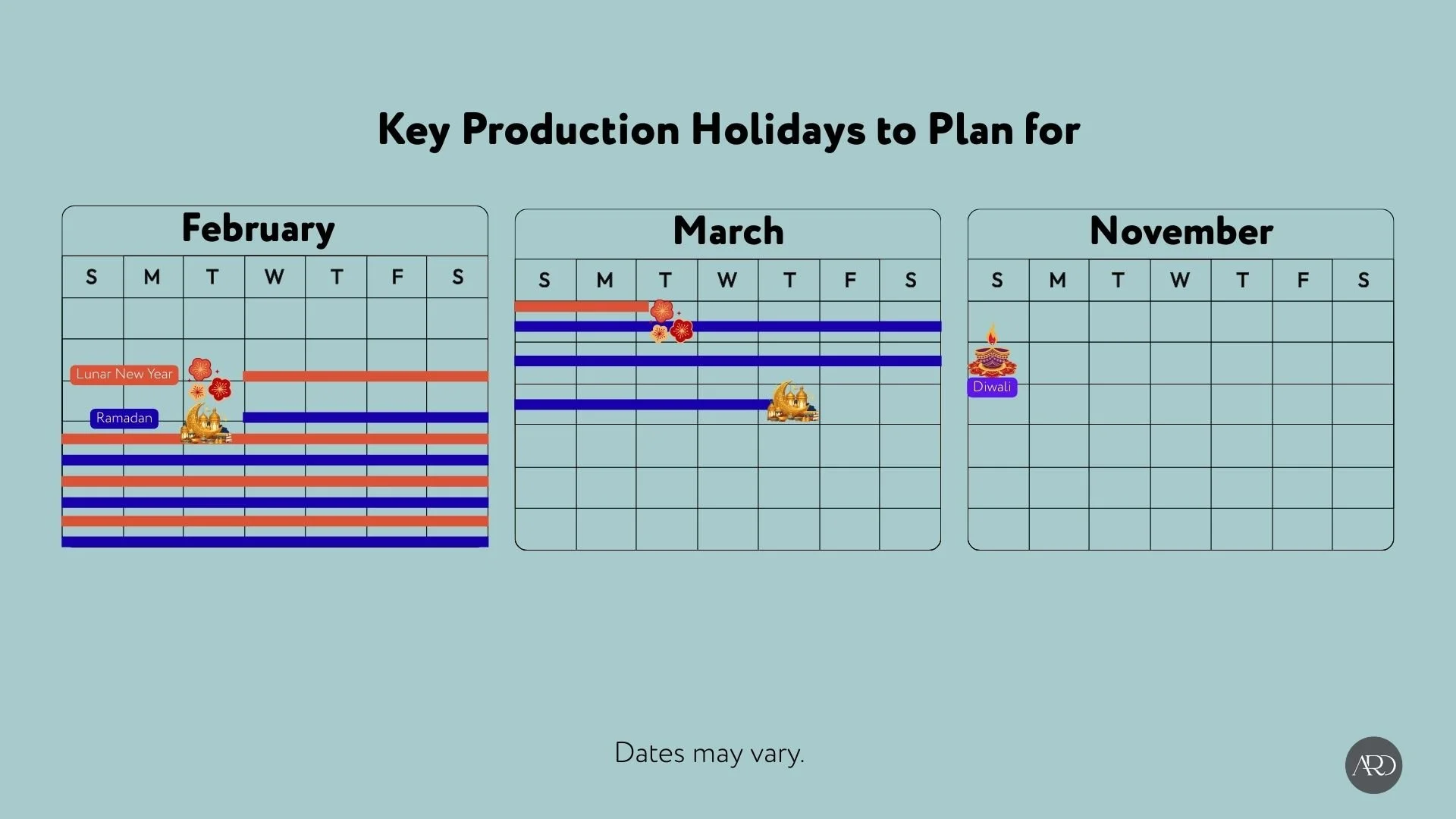
One of the fastest ways to derail your calendar? Overlooking international holidays. If you're working with global vendors, these dates can cause multi-week shutdowns, slow communication, and unexpected delays.
Here are four key holidays to plan around in 2026:
Chinese New Year (Feb 17–23)
Major shutdown across Asia. Finalize approvals by early January to avoid backlogs — even U.S. vendors with overseas partners may be affected.Ramadan & Eid al-Fitr (Feb 17 – Mar 20)
Reduced hours and full closures in Muslim-majority countries. Add buffer time if working with vendors in Bangladesh, Indonesia, or Pakistan.Holi (Mar 3–4)
Observed across India. Expect brief closures or slower response times.Diwali (Oct 17–21)
India’s largest holiday. Some factories pause for up to a week. Plan ahead if your production runs into Q4.
Founder Insight: You don’t need to track every global holiday — but your calendar should. A few smart buffers now can save you from weeks of delays later.
How Far in Advance You Should Start (2026 Guidelines)
One of the top questions we hear from founders is:
“How early do I need to start planning?”
Short answer: earlier than you think.
Real answer: it depends on your launch type, goals, and how much you’ve already developed.
Most founders underestimate timelines — especially when they’re juggling product development, sourcing, and marketing all at once.
Use these 2026 planning benchmarks to help map your calendar with clarity:
If You’re Starting From Scratch (Full Brand Launch)
Start 9–12 months before launch
This includes everything — brand strategy, product development, sourcing, sampling, production, and marketing. If you want a premium, aligned collection, give yourself the time to do it right without rushing.
Seasonal Refresh Collection
Start 6–8 months before launch
If you're reworking an existing design (like a best-seller in new colorways or prints), you can move faster — but you’ll still need time for sourcing, samples, and content creation.
Inventory Replenishment (re-orders only)
Start 3-6 months before launch
Even for restocks, factories need time for materials and production — especially if you’re scaling or entering new sales channels. Start early to avoid stockouts.

Building a Calendar That Also Supports Marketing
Planning your production timeline is only half the equation — the other half is making sure your marketing and content strategy is synced to launch alongside your product.
Here’s what to consider:
When to Schedule a Photoshoot
Your photoshoot should happen after fit approvals — but well before launch. Why? Because you’ll need time to edit, build your site, prep campaign assets, and generate buzz.
Ideal window: Schedule your shoot 8–10 weeks before launch. This gives you breathing room for edits, content creation, and a smooth rollout.
You don’t need to wait for your full production run to arrive. Use:
PP (pre-production) samples if you’re shipping by air
TOP (Top of Production) samples if you’re shipping by boat
If you’re using sea freight, ask your factory to send TOP samples by courier while the rest ships. That way, you can shoot during transit — and keep your launch on track.
Founder Tip: Aligning your shoot with your shipping timeline is one of the smartest ways to stay ahead without compromising quality.
2026 tip: Content Pipelines Must Be Planned 60–90 Days Before Launch
Your photos, emails, website, and social media all need time to be written, designed, approved, and scheduled — not done in a rush.
Example: If you’re launching in September, your marketing content should be in development by June.
Founder Insight: Many launches stall — not because the product isn’t ready, but because the content isn’t. Align your production and marketing calendars early so your brand shows up polished, not panicked.
Why Working With an Expert Saves Time + Money
Let’s Be Honest… You Don’t Have to Do This Alone
Most founders spend 6–12 extra months trying to piece this process together on their own.
They second-guess timelines, rush sampling, or waste money fixing avoidable mistakes — not because they’re unmotivated, but because they don’t have a clear roadmap or experienced partner to guide the way.
That’s exactly where we come in.
At ARD Fashion Consulting, we help founders:
Build smart, strategic calendars that align with their vision
Communicate clearly with factories and vendors
Avoid costly delays and production stress
Launch confidently — without the chaos
If you’re ready to bring your 2026 or 2027 collection to life with clarity and support at every step, we’d love to connect.
Book a Discovery Call to learn how we can support your launch from concept to delivery.