
How to Choose a Clothing Manufacturer for Your Brand: A 10-Step Guide
Finding the right clothing manufacturer can feel overwhelming, and for many founders, it’s where the process starts to feel unclear and high-risk.
At ARD Fashion Consulting, this is one of the biggest points where founders feel stuck. They have the vision, but not the roadmap.
This guide will walk you through the 10 key steps to help you choose a manufacturing partner with clarity and confidence, not guesswork.
Before you start reaching out to factories, it’s important to understand that manufacturers don’t just “figure it out” for you. The more clarity you bring into the process, the better your results will be.
Let’s start with the foundation.
Step 1. Define Your Product and Production Needs
Before you start researching manufacturers, you need clarity on what you’re actually asking them to produce.
This is one of the most common missteps we see at ARD, founders reaching out to factories too early, without enough product direction. And when that happens, manufacturers either can’t respond accurately… or worse, they move forward with assumptions that lead to costly mistakes.
Here’s what you need to define:
What type of garment are you producing?
Start simple. Are you creating activewear, loungewear, outerwear, childrenswear, or something else? Different categories require different machinery, expertise, and factory capabilities.
What materials, trims, and construction details are involved?
Even at a high level, you should understand what your product requires. Is it knit or woven? Does it include specialty fabrics, custom prints, or technical features? The more complex the garment, the more specialized your manufacturer needs to be.
What is your initial production quantity?
Are you planning a small launch or a larger run? Your projected order volume will directly impact which factories are willing, and able, to work with you.
Are you producing one style or a full collection?
Some manufacturers are better suited for single-style development, while others are structured to support multi-style collections. Knowing your scope helps narrow your search significantly.
Step 2. Understand the Different Types of Clothing Manufacturers
Not all clothing manufacturers operate the same way—and choosing the wrong type for your stage of business can create unnecessary friction, delays, and costs.
Before you begin reaching out, it’s important to understand the three main types of clothing manufacturers and how they differ.
Cut-and-Sew Manufacturers
Cut-and-sew manufacturers produce garments from custom specs or patterns, materials, and specifications. This means your product is built entirely from scratch based on your designs and tech packs.
This is the most common route for brands looking to create something unique and aligned with their vision.
Best for: brands that want full creative control
Requires: detailed tech packs, material sourcing, and development planning
Consideration: more upfront work, but greater long-term flexibility and brand differentiation
Private Label Manufacturers
Private label manufacturers offer pre-designed garments that you can customize slightly (such as color, fabric, or branding labels).
This is often a faster, lower-barrier entry point, but it comes with limitations.
Best for: testing ideas quickly or launching with lower upfront complexity
Requires: minimal development work
Consideration: limited customization and less product differentiation
Full Package Production (FPP)
Full Package Production manufacturers handle everything from sourcing and development to final production.
They act as a more hands-on partner in the process, which can be helpful, but also requires careful vetting.
Best for: founders who want more support navigating the development process
Requires: clear communication and aligned expectations
Consideration: less control over certain decisions if not managed properly
Step 3. Prepare Your Tech Pack and Design Documentation
Once you understand the type of manufacturer you need, the next step is preparing the materials they’ll use to evaluate — and eventually produce — your product.
At its core, a manufacturer cannot build from an idea alone. They build from clear, detailed instructions.
That’s where your tech pack comes in.
What is a Tech Pack?
A tech pack (short for technical package) is the blueprint of your garment. It communicates every detail a manufacturer needs to accurately produce your design.
Think of it as the shared language between you and your factory, without it, you’re relying on interpretation instead of precision.
Why Manufacturers Rely on Documentation
Manufacturers are not guessing, they are executing.
The more complete and detailed your documentation is, the more accurate your samples, pricing, and timelines will be. Without it, you risk miscommunication, multiple sampling rounds, and unnecessary development costs.
What Should Be Included in a Tech Pack?
At a minimum, your tech pack should include:
Technical Sketch (Front & Back Views)
A clear, flat drawing of your garment that shows both the front and back. This is the foundation of your tech pack, it gives the factory an immediate visual understanding of the style, proportions, and key design details.Construction Details
Information on how the garment is built, including stitch types, seam finishes, closures, and any special construction techniques. This ensures the factory understands exactly how to assemble the product.Materials
Fabric type, composition, weight, and all trims (zippers, buttons, elastics, labels, etc.). This defines both the look and performance of the garment.Labeling & Branding
Placement of logos, care labels, hang tags, and any branded elements. This ensures your product is finished and presented correctly.
Dive further into the world of technical design with our beginner’s guide.
Learn more about Technical Design
Step 4. Learn Key Manufacturing Terms Before Contacting Factories
Before you start reaching out to manufacturers, it’s important to understand the basic language of production.
You don’t need to become an expert overnight, but having a foundational understanding will help you ask better questions, evaluate responses more accurately, and move through the process with confidence.
Here are a few essential terms every founder should know:
MOQ (Minimum Order Quantity)
The minimum number of units a manufacturer requires per style, color, or order.Lead Time
The amount of time it takes to complete each phase of production, from sampling to final delivery.Sampling
The process of creating prototypes before bulk production. This typically includes multiple stages (proto, fit, and pre-production samples). You’ll also want to ensure you know the cost of each prototype up front, so it fits into your overall budget.Grading
The process of scaling your garment measurements across different sizes.Markers
The layout used to cut fabric efficiently, which directly impacts material usage and cost.Cost Sheet
A breakdown of all expenses associated with producing your garment, including materials, trims, labor, and shipping.
When you know what to ask for and how to interpret answers, you’re far less likely to be misled or caught off guard.
At ARD, we walk our clients through these terms early on so they can step into conversations with manufacturers feeling informed, not intimidated.
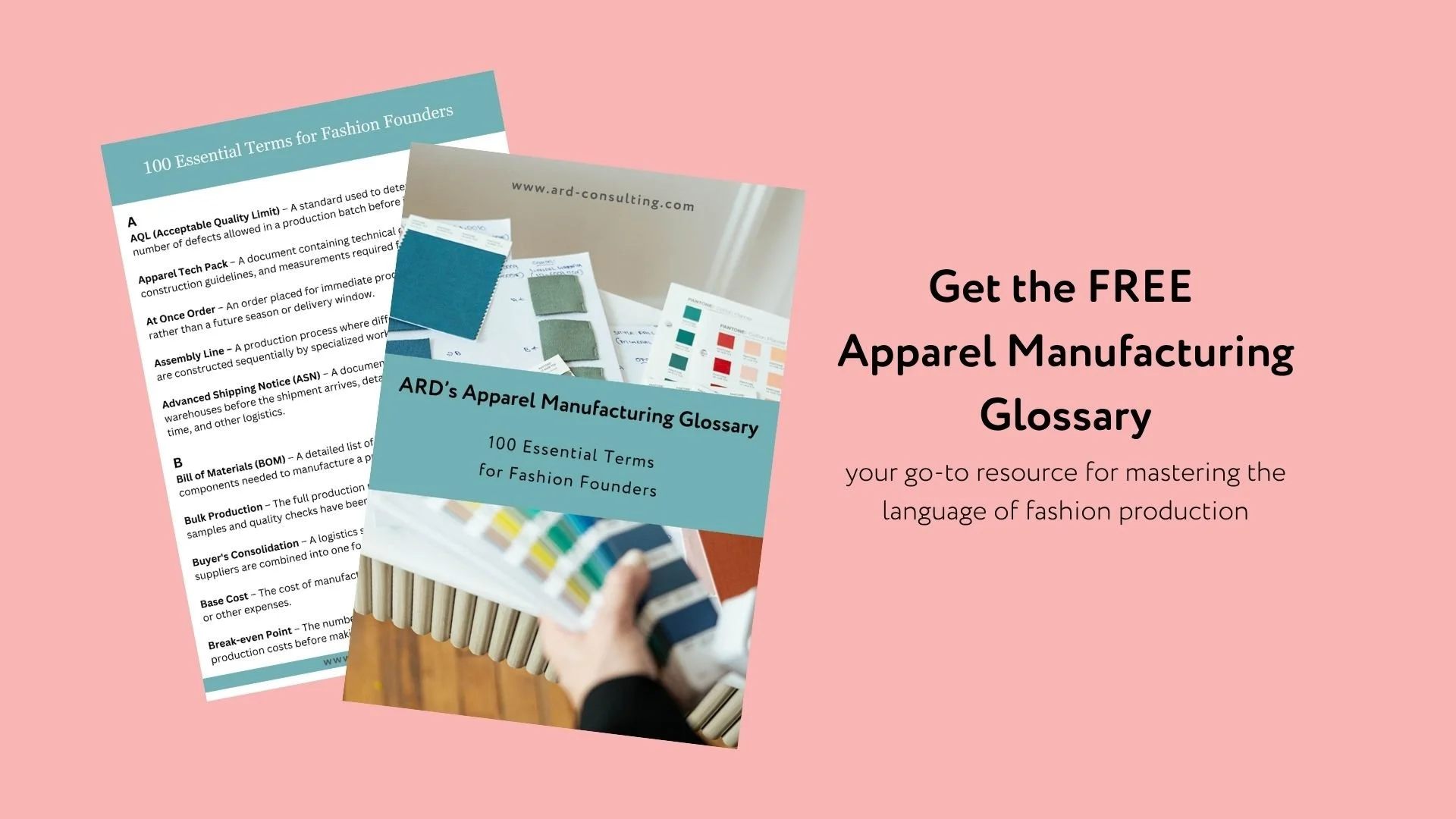
Free Resource: Manufacturer Glossary
To make this process easier, we created a Manufacturer Glossary, a simple, founder-friendly resource that breaks down 100 of the most essential production terminology in a clear and approachable way.
If you’re new to the industry, this is one of the best ways to build confidence before reaching out to factories.
Download the Manufacturer Glossary to confidently communicate with clothing manufacturers and better understand the production process.
Step 5. Research Potential Clothing Manufacturers
Once you have clarity on your product and a basic understanding of production terminology, it’s time to start researching potential manufacturing partners.
Here are a few common ways founders begin their search:
Sourcing Platforms
Websites like Alibaba, Maker’s Row, or other sourcing databases can give you access to a wide range of manufacturers. These platforms are a good starting point, but require careful vetting.Industry Directories
Curated directories often provide more targeted lists of manufacturers based on category, location, or capabilities.Trade Shows
Events like MAGIC, Texworld, or Premiere Vision allow you to meet suppliers and manufacturers in person, see materials firsthand, and start building relationships.Referrals from Industry Experts
This is often the most reliable route. Working with a consultant or someone with an established network can significantly reduce the risk of choosing the wrong partner.
How ARD Fashion Consulting Connects Clients to Reliable Vendors
One of the biggest advantages we offer at ARD is access to a vetted network of manufacturers and suppliers.
Instead of founders navigating the sourcing process alone, often relying on cold outreach or unverified platforms, we connect clients with partners we’ve already worked with and trust.
This allows us to:
Match clients with manufacturers aligned to their product category and budget
Reduce the risk of miscommunication or unreliable production
Streamline timelines by working with partners who understand our standards
For many founders, this step alone saves months of trial and error, and thousands of dollars in avoidable mistakes.
Step 6. Evaluate Minimum Order Quantities (MOQs)
One of the first things you’ll encounter when speaking with manufacturers is MOQ, Minimum Order Quantity.
This is the minimum number of units a factory requires you to produce per style, color, or order. And for many founders, this is where expectations and reality can quickly misalign.
Why Do Manufacturers Require MOQs?
Manufacturers set MOQs to ensure production is cost-effective and efficient.
Each order requires time, labor, machine setup, and material allocation. Smaller orders often aren’t profitable for factories, which is why they establish minimums.
How MOQs Impact Your Budget
Your MOQ directly affects your initial investment.
For example, a factory with a 500-unit MOQ per style can significantly increase your upfront costs, especially if you're producing multiple styles or colorways.
This is why it’s important to align your production plan with your financial capacity from the start.
How to Determine if a Factory is Startup-Friendly
Not all manufacturers are set up to work with emerging brands.
A startup-friendly factory will typically:
Offer lower MOQs (or flexibility for first-time orders)
Be open to smaller test runs or pilot productions
Communicate clearly about scaling as your brand grows
If a factory immediately pushes large quantities without understanding your business stage, that’s often a sign they may not be the right fit.
Domestic vs. Overseas MOQ Expectations
MOQ requirements can vary significantly depending on where your manufacturer is located.
Domestic factories (U.S., for example)
Often have lower MOQs, but higher per-unit costsOverseas factories (China, India, etc.)
Typically offer lower per-unit pricing, but require higher MOQs
There’s no “right” choice, it depends on your budget, timeline, and long-term production strategy.
Step 7. Request Samples and Evaluate Quality
Once you’ve identified a potential manufacturer, the next step is sampling, and this is where your product truly starts to come to life.
It’s also where many founders experience their first reality check: a perfect first sample is extremely rare.
Sampling is a process, not a one-time event.
Understanding the Sampling Stages
Most garments go through multiple sample rounds before production:
Prototype Sample (Proto)
The first version of your design. This is used to assess overall construction and basic execution.Fit Sample
Adjustments are made to improve fit, proportions, and comfort based on feedback. You’ll typically get at least 2 fit rounds to get this fit right.Pre-Production Sample (PP Sample)
The final version of your garment before bulk production. This should reflect exactly what will be manufactured.Production Sample (TOP – Top of Production)
A sample taken from the actual production run to confirm consistency.
What to Look for When Evaluating Samples
When reviewing your samples, pay attention to:
Does the garment fit the way you intended?
Are seams, stitching, and finishes clean and consistent?
Does the fabric behave as expected (stretch, drape, weight)?
Are all details aligned with your tech pack?
Step 8. Understand Pricing and Production Timelines
Before moving forward with any manufacturer, it’s important to understand two key factors that will impact your entire launch: pricing and timelines.
What Impacts Your Production Cost?
Pricing isn’t random, it’s built from several key components:
Materials
Fabric, trims, labels, and packaging all contribute to your costLabor
The complexity of your garment (and the skill required to produce it) affects labor pricingConstruction Complexity
More detailed designs require more time and precision, increasing costOrder Volume
Higher quantities typically reduce cost per unit
Understanding Production Timelines
Production happens in phases, and each one takes time:
Sampling: typically 4–6 weeks per round
Production: typically 4–12 weeks depending on complexity and factory capacity
Shipping:
Air: ~1–3 weeks
Sea: ~4–8 weeks
These timelines can vary based on seasonality, fabric availability, and global logistics. Dive further into production timelines with our beginner’s guide.
Learn more about Production Calendars
Step 9. Vet Communication and Reliability
At this stage, you may have a manufacturer that looks good on paper, but before moving forward, you need to evaluate something just as important as price or capability:
Signs of a Reliable Manufacturer
As you interact with potential partners, look for:
Clear and timely responses
Willingness to answer questions thoroughly
Transparency around pricing and timelines
Proactive communication about challenges or delays
These are indicators that the factory values the relationship, not just the transaction.
Red Flags to Watch For
Pay attention if you notice:
Vague or inconsistent answers
Slow or delayed communication early on
Unrealistically low pricing (often a sign of cut corners)
Overpromising timelines without clear breakdowns
If communication is unclear at the beginning, it rarely improves once production starts.
Step 10. Build a Long-Term Manufacturing Partnership
At this point, you’re not just placing an order, you’re beginning a relationship.
Think Beyond Your First Order
It’s easy to focus on your initial launch, but your manufacturer is also part of your long-term growth strategy.
The goal isn’t just to produce one collection. It’s to build a system that supports:
Reorders and restocks
New product development
Scaling production as demand increases
At ARD, we don’t just connect clients with manufacturers, we help them build sustainable, long-term production partnerships that support their brand beyond the first launch.
Choosing the Right Manufacturing Partner
Choosing a manufacturer is one of the most important decisions you’ll make as a fashion founder.
It directly impacts your product quality, timelines, costs, and overall brand experience.
The founders who succeed aren’t the ones who move the fastest, they’re the ones who prepare the best.
When you take the time to understand the process, ask the right questions, and build the right partnerships, you set your brand up for long-term success.
If you’re preparing to work with manufacturers and want to feel more confident in your conversations, we’ve created a resource to support you.
Download the Manufacturer Glossary to better understand the terminology used by clothing manufacturers, and communicate with clarity from day one.