
Domestic vs. Overseas Production: How to Choose What’s Right for Your Fashion Brand
Choosing where to manufacture your product is one of the most important decisions you’ll make as a fashion founder.
Domestic or overseas?
At ARD Fashion Consulting, sourcing is one of the most strategic conversations we have with clients because there’s no one-size-fits-all answer. Only what’s right for your product, your goals, and your growth plan.
In this guide, we’ll break down the real differences between domestic and overseas production, the pros and cons of each, and how to confidently choose the right path for your brand.

Before you choose your production path, it’s important to understand how each option truly operates and how those differences show up in your day-to-day business.
What is the Definition of Domestic Production and Overseas Production?
Domestic Production Defined
Domestic production refers to manufacturing within your home country. For example, an American operating with a domestic production brand would use U.S.-based factories.
This option is often associated with:
Smaller batch production
Faster turnaround times
Closer communication and oversight
Domestic manufacturing is commonly used by:
Early-stage brands testing a product
Premium or “Made in USA” positioned brands
Founders prioritizing proximity and speed
Overseas Production Defined
Overseas production refers to manufacturing in countries outside of where your business is based, such as China, India, Vietnam, Turkey, or Peru—regions known for their established apparel production infrastructure.
This is the model used by the majority of global fashion brands.
Overseas manufacturing is typically chosen for:
Cost efficiency
Scalability
Access to specialized materials and techniques
For growing brands, this is often where production becomes more strategic, not just operational.
What is the Difference Between Domestic vs. Overseas Production?
Here’s how the two compare across the factors that matter most:
Cost per Unit
Domestic: Higher
Overseas: Lower (especially at scale)
Minimum Order Quantities (MOQs)
Domestic: Lower, more flexible
Overseas: Higher, but more cost-efficient
Lead Times
Domestic: Faster
Overseas: Longer due to production + shipping
Communication & Time Zones
Domestic: Easier, real-time
Overseas: Requires structure and planning
Quality Control
Domestic: Easier to oversee in person
Overseas: Strong when managed properly, but requires clear systems
Ethical & Sustainability Considerations
Domestic: Often perceived as more ethical
Overseas: Can absolutely meet high ethical and sustainability standards when working with vetted partners and certified factories
Shipping & Logistics
Domestic: Simpler
Overseas: More complex, requires coordination

The biggest misconception is that domestic equals “better” and overseas equals “risky.”
In reality, both can produce exceptional results—or costly mistakes.
The difference comes down to strategy, preparation, and who you’re working with.
Pros and Cons of Domestic Production
Pros:
Lower MOQs (startup-friendly)
Faster sampling + production timelines
Easier communication
Perceived brand value (“Made in USA”)
Cons:
Higher cost per unit
Limited factory options depending on category
Potential capacity constraints
When speed and flexibility matter more than margin, domestic wins.
Pros and Cons of Overseas Production
Pros:
Lower cost per unit
Scalable production
Access to specialized materials and techniques
Cons:
Higher MOQs
Longer lead times
Communication barriers
Increased risk without proper vetting
ARD typically recommends this option for new brands due to its pathways for sustainable growth.
How to Decide What’s Right for Your Brand
Choosing the country of origin for your fashion brand’s manufacturing is all about aligning your production strategy with your business model.
Let’s break it down into some digestible choices.
Consider Your Budget: Can you support higher domestic costs in exchange for speed and flexibility? Or do you need lower unit costs to protect your margins and hit your price point?
Evaluate Your Order Volume: If you’re launching with smaller quantities or testing demand, domestic production often makes more sense. If you’re producing at scale, or planning to, overseas manufacturing becomes significantly more cost-effective.
Assess Your Timeline: Need to move quickly? Domestic production gives you speed and agility. Planning further ahead? Overseas production can work seamlessly with the right calendar and systems in place.
Understand Your Product Complexity: Highly technical garments, specialty fabrics, or detailed construction may require overseas factories with specific expertise and machinery.
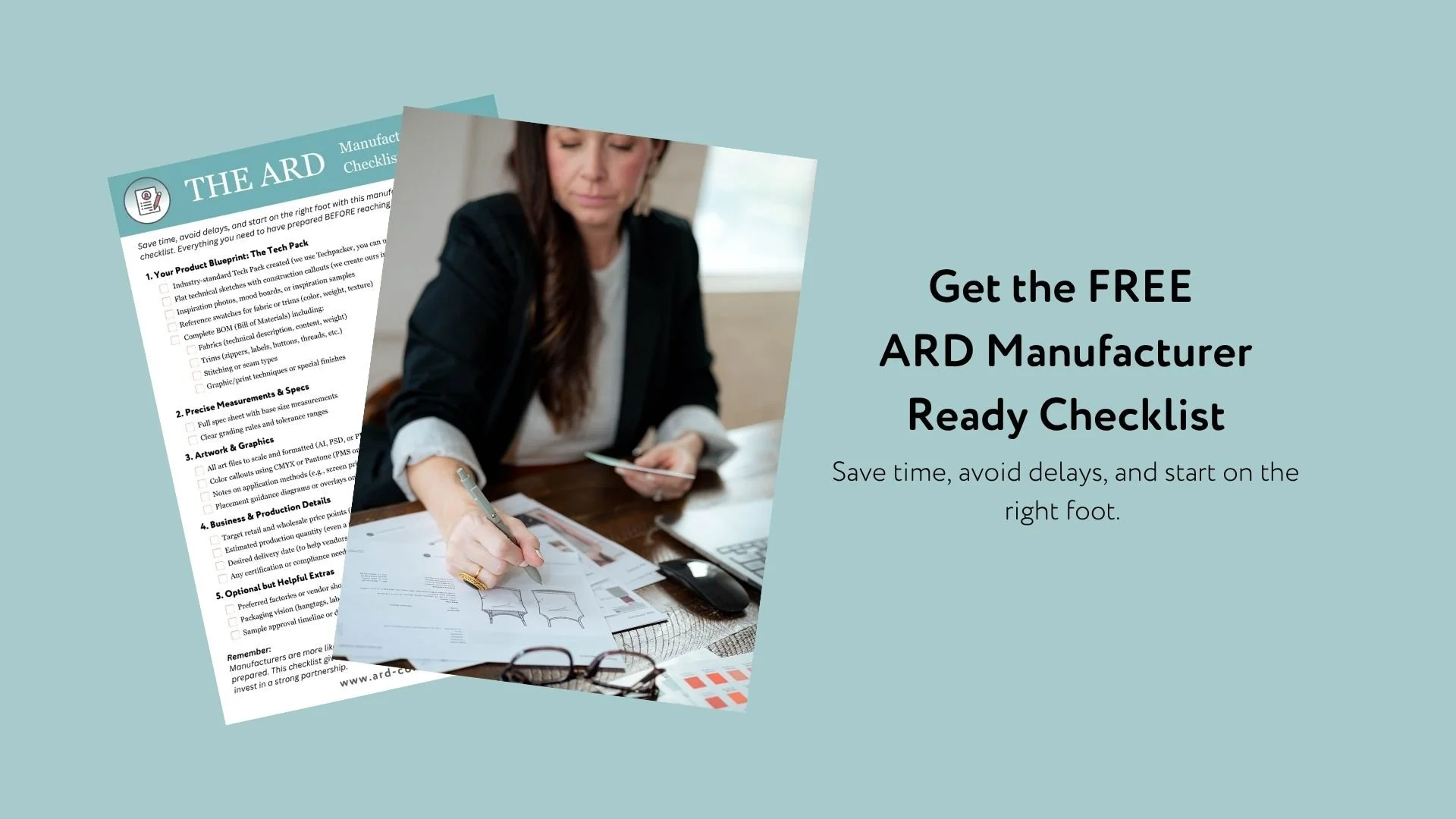
Manufacturer Ready Checklist: Taking the Next Step
Before you start contacting manufacturers, ask yourself: are you truly ready?
Having clarity on your product, budget, and production plan is what separates a smooth process from an expensive learning curve.
Download our Manufacturer Ready Checklist to ensure you’re fully prepared before reaching out to factories—and to avoid the most common (and costly) mistakes founders make early on.
Hybrid Production: When Brands Use Both
For many brands, the answer isn’t either/or—it’s both.
A hybrid production model can look like:
Starting domestic for development and small runs
Transitioning overseas for scale and margin improvement
Using domestic production for quick-turn replenishment or chase styles
This approach allows you to balance flexibility and profitability as your brand grows.
How ARD Fashion Consulting Helps You Choose the Right Production Strategy
At ARD Fashion Consulting, we don’t believe in one-size-fits-all solutions — because your brand isn’t one-size-fits-all.
We help founders make informed, strategic production decisions by offering:
Access to vetted domestic and overseas manufacturing partners
Guidance tailored to your product, budget, and growth goals
End-to-end support through development, sampling, and production
While we often work with overseas manufacturers, we strategically source across specialized countries of origin to meet each brand’s unique needs—whether that’s cost efficiency, craftsmanship, or scalability.
Choosing the Right Production Partner
Once you’ve chosen your desired production method, the next step is to find the right production partner.
In fact, the process of choosing the right manufacturer is just as important as deciding where to produce. The right partner will elevate your product. The wrong one will cost you time, money, and momentum. From vetting capabilities to understanding communication workflows, every step matters.
That’s why we break it down in our step-by-step guide to choosing a clothing manufacturer.
Ready to Build Your Production Plan?
And if you’re ready to move beyond research and start building with the right partners in place, that’s where we come in.
At ARD Fashion Consulting, we don’t just advise. We actively guide alongside you through the sourcing and production process, helping you avoid costly missteps and move forward with confidence. Whether you’re launching your first product or scaling an existing brand, our team is here to help you build a production strategy that supports long-term growth.
Ready to take the next step? Let’s build your production plan together.